
The following article is from Marianna Mamou, head of advice beyond investing, Chief Investment Office Global Wealth Management at UBS Global Wealth Management, part of , cited in the UBS report, offer a useful comparison of parental conversations among Gen Z investors and non-investors.
Among those surveyed, 79 per cent of Gen Z investors reported having parents who discussed investing with them, compared with 46 per cent of Gen Z non-investors.
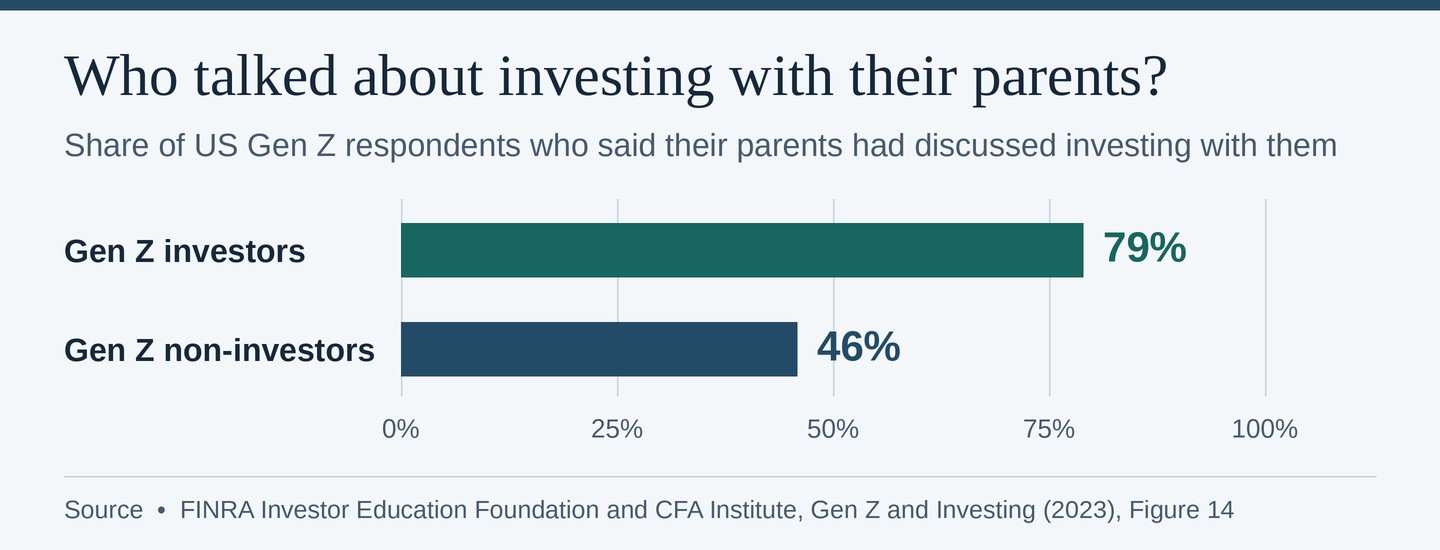
These findings suggest an association between family conversations and young adults’ participation in investing, rather than proving that parental engagement encourages children to invest.
What successful wealth transfer looks like
Ultimately, successful wealth transfer involves more than ensuring that the appropriate legal and financial structures are in place. It also means equipping future wealth holders with the judgment and confidence to make decisions independently.
This is best approached as a gradual process, with financial responsibilities increasing as children demonstrate readiness rather than simply reaching a particular age. Readiness can be seen in the ability to accept limits, explain a trade-off, learn from a mistake and ask for advice before a consequential decision.
For younger children, financial education might begin with distinguishing between needs and wants, setting savings goals and making small spending decisions. Teenagers can begin exploring budgeting, investing, diversification and the relationship between risk and return. As children reach adulthood, families can introduce more complex responsibilities, such as participating in family investment discussions, managing defined budgets or contributing to philanthropic decisions. These experiences can provide opportunities for developing financial capability.
Philanthropy can be particularly valuable for encouraging conversations about family values and the responsibilities that come with wealth. Similarly, early involvement in family governance and investment decisions can help future heirs understand how and why wealth is managed. There is no universal schedule for these financial conversations. The appropriate level of disclosure and responsibility will depend on individual maturity, family circumstances and the complexity of the wealth involved.
Regardless of when the conversations take place, a successful wealth transfer should equip the next generation with the confidence to ask questions, the discipline to consider long-term consequences and an understanding of how wealth can support both personal ambitions and wider family values.
As the Great Wealth Transfer gathers pace, families that begin these conversations early may be in a better position to prepare the next generation for the responsibilities ahead. After all, the true measure of successful wealth transfer lies not in how much the next generation inherits, but in how well prepared they are to manage it.