
Former chief executive Bob Diamond, now CEO of an investment business and chair of another, says the advent of blockchain-driven financial tech represents a “wakeup call” for London and other traditional financial centres.
Blockchain, aka distributed ledger technology, brings with it tokens and other entities that can trade 24/7, raise liquidity and challenge incumbent players’ dominance of financial markets, Diamond told the annual SALT Europe conference in London earlier this month. (The SALT conference was founded more than a decade ago by Anthony Scaramucci, also founder of SkyBridge Capital, and a brief member of the first Trump administration.)
“Over half of our volume a franchise based on old technology,” he said.
Peruccio told delegates that what makes the crypto/digital assets trend different from other financial innovations is that it has been overwhelmingly driven by retail, private clients rather than large institutions. “It has biased a lot of institutions into how they see it,” he said. “We need to reframe how we look at this.”
The panel picked up on a theme of areas such as asset tokenisation, stablecoins and other digital entities having become more mainstream in the financial services sector. This was a talking point through much of the two-day conference, held at the Chancery Rosewood in Grosvenor Square, the site of the old US embassy (main picture).
Shorten said new blockchain-based technologies create a threat to old bank network systems such as Swift, built in the 1970s. “If you’re a plumber and part of this ecosystem, there are a lot of opportunities,” he said.
Standard Chartered’s Kendrick noted that since the arrival of Donald Trump to the US presidency for a second time in 2025, there has been a surge of interest in the US in stablecoins and other entities, aided by the administration liberalising rules.
Banks must get ahead of this technology, Kendrick said.
On the second full day of the conference, your correspondent moderated a panel, “building a modern wealth portfolio,” alongside Stephanie Link, chief investment strategist and portfolio manager, Hightower Advisors; Olaolu Aganga, head of portfolio construction and analytics, Citi Wealth; and Alicia Levine, CIO, BNY Wealth. The panel addressed broad themes driving investments, such as AI, energy infrastructure growth, and the need to peer through the fog of market noise to pursue long-term returns.
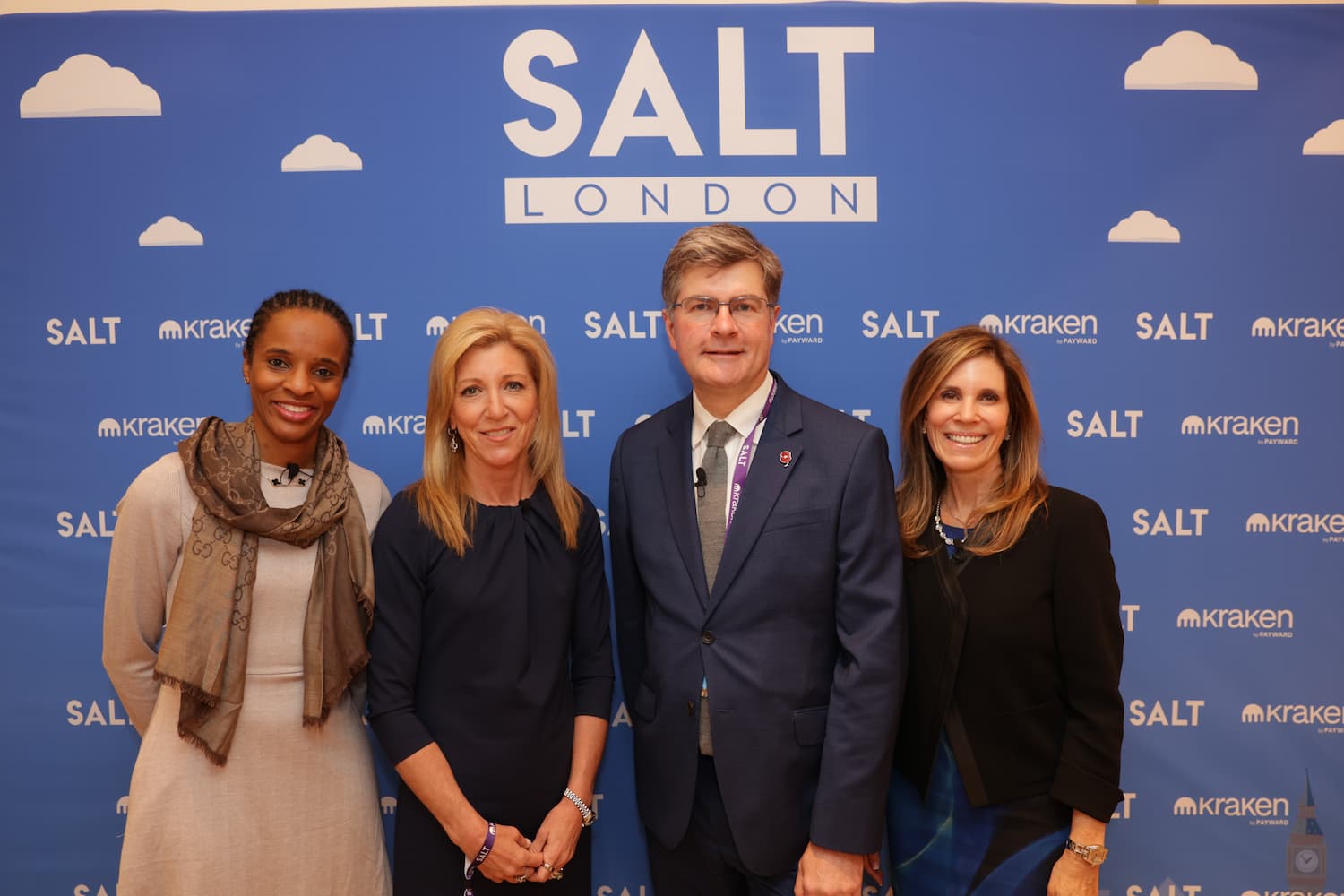
Panelists, left to right: Olaolu Aganga, Stephanie Link, Tom Burroughes, and Alicia Levine
Other speakers
Among the other panels at the conference, speakers on the first full day included J Christopher Giancarlo, former chairman, and senior strategic advisor, at the Commodity Futures Trading Commission; Anthony Scaramucci, SALT chairman; Jane Moore, head of department for payments and digital assets at the UK’s Financial Conduct Authority; Rishu Mohanka, founder, CEO and chief technology officer of Silicon Dreams; and Dr Peter Leek, founder and chief scientific officer, Oxford Quantum Circuits.
Other speakers included Maggie Fanari, CEO, J Rothschild Capital Management; Philip Chopin, head of Europe, New Enterprise Associates; Peter Carey, Axonic Capital; Katie Ramsey, head of the Global Venture Capital Unit, UK Government Office of Investment; Peter Kenyon, board advisor at Williams Racing; Maxime Seiler, CEO, co-founder, STS Digital; Vanessa Grellet, managing partner, Arche Capita; Enzo Villani, executive chairman and president, Alpha Compute; and Spencer Rayner-Cook; chief investment officer at Brevan Howard.
Continuing a mix of commentaries were Sir Richard Moore, former chief of MI6, the UK intelligence service; Jimmy McLoughlin, founder, Jimmy’s Jobs of the Future; Alastair Lukies, founder and CEO, Pollinate International; Alistair Carns, a Member of Parliament and former army officer, spoke with Rye Barcott, co-founder and CEO of With Honor; Lord John Bird, co-founder of The Big Issue, spoke with Jamie MacLeod, executive chair, Apex Wealth & Apex Foundation; and Gary Lineker, former England footballer, broadcaster and podcast businessman spoke with Katty Kay, BBC correspondent.
On the second full day, speakers included John Nahas, chief business officer of Ava Labs; Tom Callahan, CEO, Nasdaq Private Market; Alex Seddon, head of impact and private equity, M&G Investments; Matt Zhang, founder, Hivemind; Fahmi Syed, president, Midnight Foundation; Mintoo Bhandari, foundation, head of global institutional relationships, Monument Bank; Joshua Rivera, general counsel, Blockchain Capital; Michalis Fragkiadakis, director of staking, Web3 Foundation; Lord Kulveer Ranger; Katie Harries, director and head of policy for Europe and Americas, Coinbase; and Miller Whitehouse-Levine, founder and CEO, Solana Policy Institute.
Other speakers include Kathryn Sherman, cyber assistant legal attaché, US Embassy in London, FBI; Jonathan Luff, chief of global affairs and chief of staff, Recorded Future; Ben Ashworth, deputy director, National Cyber Security Center; Neil Lawrence, co-founder and chief scientist, Trent AI, University of Cambridge; Suzanne Ashman, managing partner, Sovereign AI Fund; Nick Dais, VFX Supervisor, Netflix; Nick Finegold, founder and executive chairman, Curation Capital; Alex Odagiu, CEO, BNB Standard Corporation; Mark Haefele, chief investment officer, UBS Wealth Management; and Jack Selby, MD, Thiel Capital.
As the conference concluded, the following participants reflected on the results of the US mid-term elections: Alastair Campbell, co-host, The Rest Is Politics podcast, former director of communications and strategy during the premiership of Tony Blair; and Rory Stewart, The Rest Is Politics Podcast, and former Conservative MP. Scaramucci moderated the panel.