
For as long as your correspondent has covered wealth management, a constant refrain has been the need to improve talent to meet demand. A decade ago, for example, Credit Suisse – now part of UBS – told WealthBriefingAsia that the estimated seven million millionaires in the Asia region did not have enough managers to serve them.
That number has almost certainly increased since then. On the assumption that a banker can, on average, handle 35 clients, that would translate into a need for 200,000 private bankers. At the time of that report, there were around 10,000. (More recent data puts the total number of millionaires in Asia at 10.2 million.)
In 2025, Henley & Partners, advisors to internationally mobile wealthy people, expected a net inflow of 1,600 millionaires expected that year into Singapore alone. As countries such as Thailand, Vietnam, Indonesia and Malaysia became more prosperous, for example, wealth management talent is at a premium. There are many groups that can feed into how to increase supply, and universities and business schools are in the mix.
WealthBriefingAsia recently asked (SMU) about the work it does in this area. Fittingly enough, WBA met with figures at SMU which hosted a conference of the [tag|Association of Independent Wealth Managers (Singapore)|]Association of Independent Wealth Managers (Singapore) in April (see photo below of one of the panel sessions).
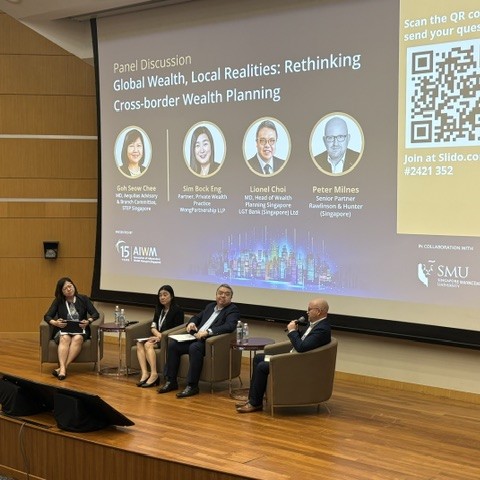
One of the panels at the AIWM (Singapore) conference in Singapore Management University in April.
“We have a talent shortage in wealth management in almost all the newly emerged wealth centres such as Singapore, Hong Kong, Dubai and others,” Professor Mandy Tham, academic director for the MSc in Wealth Management Programme at SMU said in an interview.
The MSc in Wealth Management (MWM), which has been around for more than two decades, was launched in 2004.
“Singapore aspired to build upon its financial hub status and infrastructure to become a wealth management hub. Wealth management professionals were in a shortage then and a well-structured postgraduate degree programme that combined academic rigour and practice-based curriculum was needed to build a pipeline of wealth management professionals,” she said.
MWM, which was initiated and supported by a number of industry partners, is aimed at people who already have financial sector experience under their belts.
“In the past five years, our cohort averaged around 35-year-old, with an average of 10 years of working experience. It is a diverse cohort with at least 10 different nationalities. We value diversity as wealth management is cross-border and global. There are those in their 20s who are in early-to-mid stage of their career, those in their 30s to 40s who are mid to senior level, those in their 50s who are at the management/leadership level or are wealth owners,” Prof Tham continued.
“Typically, more than half would already be in the finance or wealth management industry before joining the MWM. This subgroup comprises primarily full-time employees with financial institutions/family offices in Singapore and seeks to upgrade their knowledge and network. The rest comprise primarily international students,” she said.
“Among the international group, some are principals of family offices/family businesses and their NextGen learning to manage family wealth. Some had worked in the finance/wealth management industry overseas and they want to enter the wealth management industry in Singapore.
Some of them are career switchers looking to pivot into wealth management,” Prof Tham said.
One trend is that more NextGen figures and principals of family offices are entering the programme, which makes sense given the passing of time and surge in family offices in Singapore in recent years.
The need for training
Several banks and academic institutions are building programmes and courses around the world, for example in London, Geneva and the US.
In September last year, the London Business School teamed up with HSBC to create a new wealth academy. In the US, Dynasty Financial Partners has worked with the MIT Sloan Business School, gathering the heads of the wealth managers in its network of firms to work through AI use cases. Among other specific examples are Imperial College London, which has a MSc in Investment and Wealth Management; the London School of Finance and Law has a diploma course in Investment and Wealth Management. Queen Mary University of London has a Wealth Management MSc. Wharton and Columbia University School of Professional Studies run courses in wealth management. In Europe, examples include Geneva University and its MSc in Wealth Management.
While these organisations compete to some extent for students, there is also a degree of collaboration and partnership. The networking impact of attending these courses is important.
Singapore’s focus
Singapore’s policymakers want the city-state to thrive in this sector, and close partnerships between academia and the businesses of banking and advising wealth are a clear priority.
Prof Tham said the MSc course has embedded the Institute of Banking & Finance (IBF)’s accreditation for wealth management seamlessly into its academic curriculum since 2018.
WealthBriefingAsia asked Prof Tham what are the benefits of holding these MScs?
She replied that first of all, a holder is “job-ready for the private banking sector for those at junior/entry level”; it upgrades the knowledge of those already in the sector, enabling them to progress their careers; it also gives knowledge to wealth owners and their children; it creates a safe environment for forming a network; there is internship and career placement support, and lifelong learning support from SMU. Other benefits include opportunities to study overseas, in the UK and Switzerland for example, and benefit from the advantages of a strong alumni network. (The course involves “blocks” in the University of St Gallen, Switzerland, and Cambridge Judge Business School in the UK.)
With regulations changing and increasing – affecting anti-money laundering, family office governance, etc – the need for ever more knowledge is clear. Like many other parts of the world, Singapore and the wider region face intergenerational wealth transfer and succession challenges.
“Technical knowledge is needed. Clients are getting more sophisticated. I have a sizeable number of NextGens on the MWM who had at least one other MSc before joining the MWM programme,” Prof Tham said.
There are also emotional, political and strategic elements to consider for students. The emotional aspect, for example, covers people skills, building a rapport with a client and showing empathy; the strategic side grapples with helping clients chart a long-term course; and the political savviness addresses some of the sensitivities in wealth management, Prof Tham added.
The role of academia came up earlier this year when this news service spoke to the about international studies and geopolitics in the wealth management sector.